



Short answer: a one-car garage usually starts in the 30-40 pint class, a two-car garage lands around 40-50 pints, and a large or soggy garage can need 50-70 pints or more. Pints measure how much water a unit pulls from the air in 24 hours, not the machine's size or bucket. That range is just a starting point, though. The real answer to what size dehumidifier for garage use depends on your square footage, humidity readings, ceiling height, air leaks, climate, and what's actually adding moisture to the space. Here’s how to narrow that range using your garage’s floor area, humidity level, ceiling height, temperature, and moisture sources.
Quick Garage Dehumidifier Size Chart
Treat this chart as a shopping starting point for your garage dehumidifier size, not a finished calculation. Before comparing two units by pint rating, check that both were tested under the same conditions. The mismatch is the number one reason people end up with the wrong size.
|
Garage type |
Typical square footage |
Moisture condition |
Starting capacity class |
Notes |
|
One-car garage |
Roughly 200–350 sq ft |
Moderately damp |
30–40 pint class |
Check the rating standard and confirm your actual RH before buying. |
|
Two-car garage |
Roughly 400–600 sq ft |
Moderately to very damp |
40–50 pint class |
A 50-pint unit is a common starting point, not a rule that fits every layout. |
|
Three-car or oversized garage |
Roughly 600–1,000 sq ft |
Very damp, or door opens frequently |
50–70 pint class |
Adjust upward for tall ceilings, a leaky building envelope, cold climates, or wet vehicles. |
|
Large or heavily used garage |
800–1,200+ sq ft, or a severe moisture load |
Persistently wet, high moisture load |
70 pint class or commercial-duty unit |
Fix any active leaks or standing water first; capacity alone won't solve a source problem. |
That gets you in the right neighborhood, not an exact number. Confirm the test condition behind any pint figure you're comparing.
What Does Dehumidifier "Size" Mean?
Capacity Is Measured in Pints per Day
"Size" means how many pints of water a unit removes from the air in 24 hours under lab conditions, nothing to do with cabinet dimensions or bucket volume. A compact unit can have a high pints-per-day rating, while a physically larger unit may have a lower capacity.
Figuring out how large a dehumidifier your garage needs depends on its moisture-removal capacity, not the size of its cabinet. Most garage-duty units drain through a hose instead of a bucket anyway, which helps with hands-off operation but has nothing to do with capacity.
Why Pint Ratings Can Be Misleading
Pint ratings only line up when they're tested the same way, and a few test conditions are still floating around. The current U.S. DOE test for portable dehumidifiers runs at 65°F and 60% RH.
Before 2019, portable units were tested at a warmer 80°F and the same 60% RH. Warmer air holds more moisture, so older tests produced bigger pint numbers for the same physical machine.
ENERGY STAR's own conversion chart confirms this: an old "50 pint" rating roughly matches a "30 pint" rating today, and an old "70 pint" unit lines up with roughly "40-45 pints" now.
Treat that as a rough guide, not an exact swap, since it varies by model. This is exactly where the 30-pint vs 50-pint dehumidifier question trips people up: a 30-pint unit tested at 65°F can move about the same water as an older 50-pint unit tested at 80°F, even though the labels look worlds apart.
One more wrinkle: many garage- and crawl-space-style units publish a saturation rating, often near 90°F/90% RH, right alongside a more conservative AHAM figure. A single unit can legitimately be marketed as both "113 pints" and "53 pints," depending on which number you're reading. Check which condition backs the figure before sizing against your garage dehumidifier size target.

Why CFM Airflow Matters in a Garage (Not Just Pints)
Pint capacity tells you how much water a unit removes from air that reaches its coil. Airflow, measured in CFM, decides how much air gets there in the first place. A long, narrow garage, a workbench blocking airflow, or a parking bay plus a workshop corner all need a unit that moves air well, not just one with a high pint number sitting in a single spot.
Measure the Garage Before Choosing Capacity
Grab a tape measure and a hygrometer before you look at a single product listing.
Calculate Floor Area
Measure length times width instead of trusting the "one-car" or "two-car" label. Layouts swing by hundreds of square feet even within the same car count; a narrow tandem bay and a wide side-by-side bay aren't the same space. Use your actual square footage against the chart above, not the listing label.
Account for Ceiling Height and Air Volume
Sizing charts usually assume an 8-foot ceiling. A taller garage, or one with open rafters and a storage loft, holds more air than the floor plan suggests, so it's often worth moving up a capacity class.
Measure Relative Humidity
Grab a cheap hygrometer and check RH a few times over several days instead of guessing. The EPA recommends keeping indoor humidity below 60% to limit mold growth.
A garage that briefly hits 55-60% after a rainstorm is a different animal than one that sits above 70% no matter the weather; the second case points toward a bigger capacity class or an active leak, not just more machine.
Determine the Garage's Moisture Load
Moderately Damp, Very Damp, or Wet
A heavier moisture load needs more extraction capacity, and you can gauge that load without any equipment. Moderately damp shows up as an occasional musty smell.
Very damp feels clammy, fogs cold surfaces, and leaves cardboard soft to the touch. Wet means active water, puddles, soaked drywall, standing water after storms. Match your capacity class to whichever fits, then adjust with the factors below.
Garage-Specific Moisture Sources
Garages pick up moisture in ways living spaces don't:
● Wet vehicles drying out after rain or snow
● Rain or snow blown in through the door
● Moisture wicking up through bare concrete
● Roof, gutter, or plumbing leaks
● A laundry setup or home gym sharing the space
● Frequent door openings that swap dry air for humid outside air
That last one deserves a name: uncontrolled outdoor-air exchange. The goal isn't zero air movement; it's cutting the uncontrolled kind. A lot of that comes down to sealing gaps around the door and slab rather than running a bigger machine, and tightening up the garage before adding equipment often knocks humidity down before a dehumidifier ever kicks on.
Fix Bulk Water First
A roof leak, a plumbing leak, bad grading, or a puddle on the floor is a repair job, not a capacity job. A bigger dehumidifier just works harder chasing an active leak; it won't fix it. Patch the source first, then size the unit for whatever humidity is left.
How Air Leakage Affects Your Required Capacity (ACH)
Gaps around the door, unsealed vents, and worn weatherstripping let outside air trade places with inside air, and that exchange carries moisture with it. The leakier the garage, the harder the dehumidifier works just to keep pace, separate from anything happening inside the space. Sealing those gaps often lets a smaller unit do a bigger unit's job.
That's about tightening the garage itself, not piping conditioned air over from the house. An attached garage should stay its own air zone for safety, no matter how well it's sealed. Whether an attached garage can even take a standard dehumidifier safely is worth settling before you shop for capacity.
Suggested Capacity by Garage Type
Car count is a rough alternative for garage dehumidifier size; square footage and moisture load decide the real number.
Dehumidifier Size for a One-Car Garage
Dehumidifier size for one-car garage spaces usually starts at 30-40 pints for a moderately damp bay in the 200-350 sq ft range. Push toward the top of that range, or up a class, if RH sits above 60% most of the time, the ceiling runs taller than 8 feet, or the door seals are shot. A tight, moderately damp garage on the smaller end can often get by with the lower number.
Dehumidifier Size for a Two-Car Garage
Dehumidifier size for two-car garage spaces usually starts around 40-50 pints, covering the 400-600 sq ft a typical two-bay garage takes up. People often ask if a 30-pint unit is enough for two cars. Maybe, in a small, tight, only moderately damp space- but it can fall short once RH climbs, the door gets used constantly, or vehicles come in wet.
That's the real-world version of the 30-pint vs 50-pint dehumidifier question: a 30-pint unit rated at today's 65°F standard can hold its own in a light-load two-car garage, while a heavier load usually calls for 50.
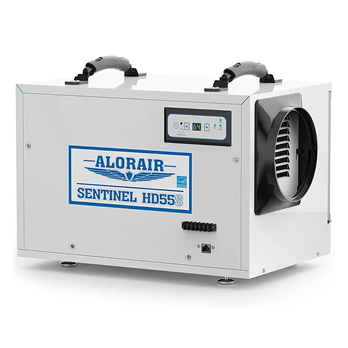
For a two-car garage carrying a real moisture load, the Sentinel HD55S is built for it: 55 PPD at AHAM conditions (120 PPD at saturation), sized for spaces up to about 1,300 sq ft, with continuous gravity drainage instead of a bucket, automatic defrost, and a corrosion-resistant coil that holds up against road salt and exhaust residue.
If checking humidity from your phone beats walking out to the garage, the Sentinel HD55 WiFi delivers similar capacity (53 PPD at AHAM, 113 at saturation, sized for roughly 1,200 sq ft) with app control built in. Both share the same 33.8-104°F operating range, so the choice really comes down to Wi-Fi or no Wi-Fi.
Three-Car or Oversized Garage
Garages between 600 and 1,000 sq ft, or ones that are very damp, opened constantly, or juggling parking, storage, and projects at once, generally need 50-70 pints or commercial-duty equipment.
Don't size off car count alone; a tight three-car garage can need less than the chart suggests, and a two-car garage with a workshop attached can need more. Go by square footage, RH, and moisture sources instead.
AlorAir's own garage setups often lean on this larger capacity class, and the garage applications show how that plays out in bigger, multi-use spaces.
Workshop, Classic-Car Storage, Home Gym, or Laundry Use
A garage doing double duty as a workshop, classic-car storage, gym, or laundry room often needs more margin than square footage alone suggests. Classic cars and woodworking tools want tighter, steadier RH to avoid rust and warping.
A gym adds sweat and body moisture; laundry adds moisture every cycle. Lean toward the top of your capacity class here, favor continuous drainage over a bucket, and look at commercial-duty construction for heavier, constant loads.
Adjust for Temperature and Climate
Cold Garages
Check the minimum operating temperature and automatic defrost before buying for a cold garage. Refrigerant units lose steam as temperatures drop, and without defrost, the coil ices over and stops pulling moisture.
Desiccant units, which pull moisture with an absorbent material instead of a coil, make sense when temperatures run colder than a refrigerant unit can handle, not because they're more efficient across the board.
Hot, Humid Garages
In consistently hot and humid climates—Florida is a common example—a garage takes in moist outdoor air almost every time the door opens.
Maximum operating temperature matters as much as the low-end rating here; for anyone chasing what actually holds up in that kind of heat and humidity, what works best in a Florida garage is worth a look before you buy.
When to Add a Sizing Margin
Increase a capacity class when several factors stack together: high RH, a tall ceiling, constant door traffic, wet vehicles, a leaky envelope, and a hot-humid climate all at once add up to more load than any one factor alone.
No fixed percentage covers every combination. Treat one factor as a reason to lean high in your range, and several together as a reason to move up a class.

Common Garage Dehumidifier Sizing Mistakes
1. Sizing only by car count. A "two-car garage" figure ignores actual square footage, which can vary by hundreds of feet between layouts.
2. Comparing pint figures measured under different test conditions. A 50-pint unit rated at 80°F and a 50-pint unit rated at 65°F are not the same machine in practice.
3. Ignoring ceiling height, temperature, climate, air leakage, and door-opening frequency. These factors shift the real-world load well beyond what square footage alone predicts.
4. Choosing by bucket size instead of moisture-removal capacity. Bucket volume affects how often you empty a non-draining unit; it has nothing to do with how much water the unit can pull from the air per day.
5. Using a larger unit as a substitute for repairing leaks or drainage problems. Bulk water intrusion is a source-control issue, not a capacity issue.
6. Buying for headline capacity while ignoring drainage and operating-temperature limits. A high-PPD unit that can't drain continuously or can't run at your garage's winter temperature won't deliver its rated performance where you need it.
Frequently Asked Questions
What size dehumidifier do I need for a one-car garage?
30-40 pints covers most moderately damp one-car garages. Check the rating standard and adjust for high RH, a tall ceiling, or drafty seals.
What size dehumidifier do I need for a two-car garage?
40-50 pints is the usual starting point. A very damp, tall, or frequently opened two-car garage may need more.
Is a 50-pint dehumidifier enough for a garage?
Often, for a typical two-car garage under moderate conditions. That's the heart of the 30-pint vs 50-pint comparison; it depends on the test standard behind the number and how heavy your actual load runs.
What size dehumidifier do I need for 500 square feet?
Start around the 40–50 pint class for a 500 sq ft garage with moderate-to-high humidity, then adjust based on ceiling height, garage temperature, and any specific moisture sources like wet vehicles or a leaky door seal.
What size dehumidifier do I need for 1,000 square feet?
50-70 pints, or a commercial-duty unit, fits most 1,000 sq ft garages under heavy conditions. Let measured RH confirm the choice rather than square footage alone.
Conclusion
Work the sequence in order: measure the garage, log RH and temperature over a few days, pin down where the moisture is actually coming from, then compare pint ratings only when they're tested under the same standard. Pick a starting class from there, and give it some margin if a few load factors stack up at once. Skip that order, start with a pint number instead, and you end up sizing off a label that may not even mean what you think it means.
Ready to Dry Out Your Garage?
Once you know your numbers, compare models the way you sized the space: verified capacity under a stated test condition, operating temperature range, how it drains, and whether it's built for light or heavy-duty, not just the biggest pint figure on the box. Explore the AlorAir lineup of dehumidifiers.


