



Your dehumidifier pulls water out of the air all day, and that water has to go somewhere. If it can't drain properly, the unit may shut off or water may back up. Nobody wants to crawl back under the house with a mop.
So, does your crawl space dehumidifier need a pump, or will gravity drainage do the job? It mostly comes down to the drain route. If water can flow downhill to an approved discharge point, gravity may be enough. If the route needs to go uphill, you'll need a pump. Here's how to choose and what to check before installation.
Quick Answer: Do You Need a Pump or Gravity Drain?
Use a gravity drain when a hose can run continuously downhill from the dehumidifier to an approved drain point. Use a pump when any part of that route has to climb, or when the drain point sits above the unit. So, do you need a pump for a crawl space dehumidifier? Only when gravity can't carry the water to where it needs to go.
The 30-Second Decision Rule
Answer these three questions before choosing your drainage setup:
- Do you have an approved place to discharge the water? A floor drain, sump basin, or outdoor discharge point may work, depending on local requirements.
- Is the discharge point lower than the dehumidifier's gravity drain outlet?
- Can the drain line follow a continuous downhill path? Check for uphill sections, low spots, and obstacles that could interrupt the flow.
If all three answers are yes, gravity drainage may work, provided your dehumidifier supports it. If the drain route needs to go uphill, a condensate pump is the better option. If you don't have an approved discharge point, solve that problem first—a pump alone won't fix it.

Why Most Crawl Space Installs Lean Toward a Pump
Crawl space installs often lean toward pumps because the dehumidifier usually sits at or near the lowest point in the space, while the nearest approved drain point is often higher or farther away. In that case, gravity has no downhill path to work with.
This is a common pattern, not a rule. A crawl space with a floor drain, or an exterior discharge point below the unit, may drain by gravity without a pump.
How Gravity Drainage and Condensate Pumps Work
Moisture condenses on the cold coil and leaves through a drain outlet. The difference between gravity drainage and a condensate pump is simple: gravity lets water flow downhill, while a pump moves it when the route can't stay downhill.
How a Gravity Drain Moves Water
A gravity drain sends that water through a hose that runs downhill to the drain point. The drainage itself uses no electricity, because the height difference does the work. The compromise is that the outlet must sit above the discharge point and the hose must keep falling the whole way. A dip anywhere in the run may trap water and slow the flow.
How a Condensate Pump Moves Water
A condensate pump collects the water in a small reservoir and pushes it through a discharge hose when the level rises. Pumps typically use a float switch, so they run only when there is water to move.
Because the pump creates the pressure, the hose can run level or uphill, as long as the route stays within the pump's rated lift and hose length. A built-in pump sits inside the dehumidifier. An external pump is a separate unit that connects to the drain outlet and typically needs its own power connection.
Pump vs Gravity Drain: Side-by-Side Comparison
Gravity is simpler, and a pump is more flexible. In a crawl space dehumidifier pump vs gravity drain comparison, your route decides the winner.
|
Factor |
Gravity drain |
Pump (built-in or external) |
|
Upfront cost |
Usually lower, since there is no pump hardware to buy |
Typically higher, because the pump is built into the unit or bought as an add-on |
|
Installation |
Simple when the route falls all the way, but the hose needs careful routing and support |
More flexible routing, but it needs a discharge hose sized and secured for the lift |
|
Power needs |
None for drainage |
The pump draws electricity, and an external pump usually needs its own connection |
|
Maintenance |
Check for kinks, sags, and clogs |
The same hose checks, plus periodic pump and reservoir cleaning |
|
Reliability |
Few moving parts, but a blockage or low spot can stop the flow |
The motor and float can be damaged, and a failed pump may interrupt drainage |
|
Best fit |
Crawl spaces with a floor drain or discharge point below the unit |
Crawl spaces where the drain point is higher, farther away, or hard to reach with a downhill hose |
When Can a Crawl Space Dehumidifier Use a Gravity Drain?
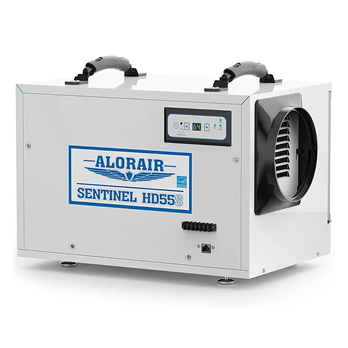
A crawl space dehumidifier can drain by gravity when the drain point sits below its outlet. Then you can skip the pump with a gravity-drain model like the Sentinel HD55S. It covers up to 1,300 square feet and removes 55 pints per day under AHAM (Association of Home Appliance Manufacturers) conditions of 80°F and 60% relative humidity.
The Slope You Actually Need (⅛ Inch per Foot Minimum)
The International Mechanical Code (IMC) sets a minimum slope of ⅛ inch per foot for condensate piping, so a 10-foot run needs at least 1¼ inches of drop. The code targets HVAC condensate, so treat it as a benchmark and check local rules.
Minimum Pipe Size and Termination Point
Condensate from a crawl space dehumidifier should be routed to an approved disposal point. The International Mechanical Code (IMC) specifies a minimum ¾-inch pipe size for certain condensate drain piping, but that doesn't automatically mean every dehumidifier needs a hose with a ¾-inch inside diameter.
Your dehumidifier's drain connection and the manufacturer's instructions determine which hose or tubing is suitable for the unit. Before installation, check which drain hose size suits your dehumidifier and confirm that your drainage setup meets local requirements.
Common Crawl Space Obstacles to Gravity Drainage
Crawl spaces often add physical obstacles that break a downhill route. Footings and piers can force a hose to climb, joists and ductwork can force sags, and a floor that slopes away from the drain can cancel the fall you need. Low clearance also limits how much height you can gain. Before you commit to gravity, check the whole route with a level or string line, and plan to support the hose at intervals so the fall stays continuous.
When Does a Crawl Space Dehumidifier Need a Pump?
You need a pump when no downhill route exists.
No Usable Slope, or the Drain Point Is Uphill
If the only approved drain sits above the unit's outlet, gravity can't help. A pump fixes that, and the Sentinel HD35P with a built-in condensate pump is one way to get it. It lifts water up to 19.6 feet through its included 19.6-foot hose, and it ships with a 6.56-foot gravity hose, so one unit handles either setup.
Long Horizontal Runs to the Termination Point
The longer a gravity drain line runs, the more total drop it needs. At a slope of ⅛ inch per foot, a 40-foot run needs 5 inches of drop. That can be difficult in a low-clearance crawl space, especially when footings or other obstacles get in the way.
A pump can help when there's not enough elevation for gravity drainage. Just remember that longer discharge lines also add resistance, so check the pump's rated performance and installation requirements before choosing one.
Why Crawl Spaces Need Pumps More Often Than Basements
Crawl spaces leave little headroom to raise the unit, and many have no floor drain. Low clearance narrows your options, so look for a pump-equipped model that fits your crawl space's height and square footage.
Built-In Pump vs External Condensate Pump
The built-in pump vs external condensate pump choice affects setup and service. One lives inside the unit. The other connects to its drain outlet.
What a Built-In Pump Offers
A built-in pump comes matched to the unit, so there is one power connection, no extra device to mount, and a discharge hose supplied by the manufacturer. That simplicity helps in tight crawl spaces where every added component takes up room.
The Galaxy 60P shows how this works in a larger unit. It is rated for up to 1,800 square feet, removes 145 pints per day at saturation and 60 pints per day under AHAM conditions, and can drain by gravity or pump. Moreover, it moves 165 CFM of air, operates from 37.4°F to 100.4°F at 35% to 90% RH, and measures 21.3 by 11.7 by 14.15 inches at 47.5 pounds.
What an External Condensate Pump Offers
You can replace an external pump without touching the dehumidifier, and you can add one to a gravity-only unit if its reservoir sits below the drain outlet. The catches: another power connection and more joints that can leak.
Which One Costs Less Over Time
No solid failure-rate data exists, so cost depends on who pays when a pump quits. Pump life varies with runtime, debris in the condensate, and maintenance. Failure cost is where the designs differ. An external pump can usually be replaced on its own, which may make replacement simpler and cheaper than repairing a pump built into the cabinet. Warranty terms matter too.
How to Plan the Drain Route Before Choosing a Unit
Plan the route on paper first: distance, height change, and a legal endpoint.

Map the Distance and Elevation to Your Termination Point
Measure the actual route from the dehumidifier to the discharge point, including bends and obstacles. For gravity drainage, compare the outlet height with the discharge point and make sure the entire line can slope downward. If you're using ⅛ inch per foot as your installation guideline, calculate the total drop needed for the full run.
For pump drainage, measure the vertical rise to the highest point and the total discharge line length. You'll need both measurements to check whether the pump can handle the route.
Check for a Nearby Sump Basin or Floor Drain
A nearby floor drain or sump basin may be a convenient discharge point, but confirm that the connection is allowed by local code. If draining into a sump, follow the applicable requirements for an approved connection or air gap, and make sure the discharge arrangement won't allow water to back up into the hose.
For outdoor discharge, choose an approved location that directs water away from the foundation without creating standing water or a nuisance. The International Residential Code (IRC) generally requires the surrounding ground to slope away from foundation walls, including a 6-inch fall within the first 10 feet where applicable. That's a site-grading requirement, not the slope required for the condensate hose itself.
Match Pump Lift Height to Your Actual Route
Rated lift is the maximum vertical rise, so measure to the highest point. The hose must also cover the whole path. A route that rises 8 feet, then runs 15 feet across, needs about 23 feet of hose. That clears a 19.6-foot lift but outruns a 19.6-foot hose.
What to Check After Installation
Once you've completed your crawl space dehumidifier installation, check the drainage setup before leaving the unit to run unattended.
- Check for Leaks and Blockages: Inspect the hose, connections, and discharge point for drips, kinks, or standing water. If the unit isn't producing much condensate, check the drainage again when it's running under humid conditions.
- Test the Pump and Safety Features: If your model has a condensate pump, float switch, or overflow protection, follow the manufacturer's test procedure. Check the auto-restart function only if your model supports it and the manual explains how to test it safely.
- Watch for Drainage Problems: Unusual pump noise, water around the unit, or a pump that runs without moving water may indicate a problem. Start by checking the hose and discharge point before inspecting the pump.
Frequently Asked Questions
Can a crawl space dehumidifier drain uphill?
Not by gravity. Water only flows downhill, so an uphill route needs a pump. The pump has to be rated for the vertical rise, and the hose has to be long enough for the entire route.
Can I add an external pump to a gravity-drain dehumidifier?
Often, yes, if the dehumidifier's drain outlet can feed the pump and the pump's reservoir can sit below that outlet. Check with the manufacturer first, because added equipment may affect service or warranty terms. If you are still shopping, a model with pump drainage avoids the add-on.
How high can a dehumidifier pump lift water?
It depends on the pump. Every condensate pump has a rated maximum lift, and the number varies by model. You'll find it in the manual or on the spec sheet. Measure the rise from the pump to the highest point on your route, not just to the discharge end. Check the rated hose length too, because the hose has to cover the whole path, not only the vertical climb.
Can I drain a crawl space dehumidifier into a sump basin?
Often, if your local code accepts it, secure the hose end above the basin's high-water level so it can't be submerged, and confirm that the basin itself discharges to an approved location.
What happens if the condensate pump fails?
Water stops leaving the unit, so it may shut off or overflow. If your model also drains by gravity and a downhill route exists, use that hose until you fix the pump.
Wrap Up
Choosing between a condensate pump and gravity drainage comes down to your drain route. If water can flow downhill to an approved discharge point, gravity drainage keeps things simple. If the route needs to climb, a pump gives you more flexibility—as long as it's rated for the job.
Measure the route before buying, check your local drainage requirements, and choose a setup you can maintain. If you're still comparing options, AlorAir's crawl space and basement dehumidifiers include both gravity-drain and pump-equipped models.


