
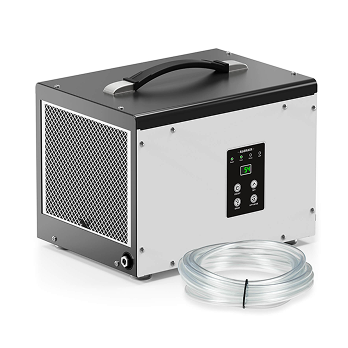
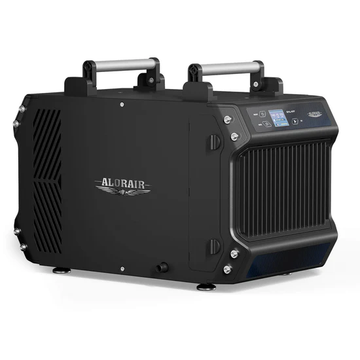
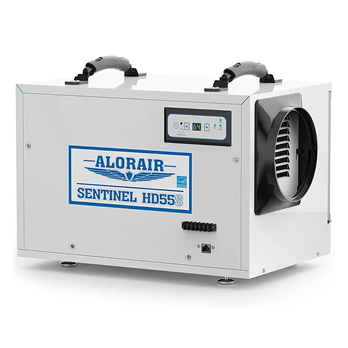
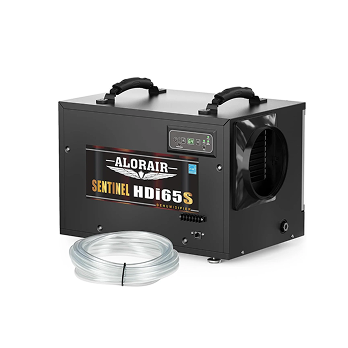



Quick Answer: A dehumidifier can help when your AC cools the home but indoor humidity remains high. Removing excess moisture may improve comfort, control humidity during short AC cycles, and allow you to use a higher thermostat setting. However, it does not make the air conditioner itself more efficient, and it will not automatically lower your electric bill. A dehumidifier uses electricity and releases heat, so the result depends on your indoor RH, climate, moisture source, equipment sizing, and how the two systems are controlled.
How Can a Dehumidifier Help an Air Conditioner?
An air conditioner removes heat and moisture at the same time as indoor air passes over its cold evaporator coil. However, it only dehumidifies effectively while the compressor is running. If the AC reaches the temperature setting quickly or has little reason to run during mild weather, indoor humidity may remain high.
A dehumidifier removes moisture independently of the cooling demand. It can therefore improve comfort when the home is cool enough but still feels damp. It does not increase the AC’s mechanical efficiency or SEER rating, and because it uses electricity and releases heat, it does not automatically reduce total energy use.
How an Air Conditioner Removes Moisture
An air conditioner only removes meaningful moisture while the compressor is running and the evaporator coil is cold enough to make water vapor condense. If the compressor cycles off quickly, that dehumidification window closes early, even though the room may have already reached the set temperature.
What a Dehumidifier Does Differently
A dehumidifier doesn't need to lower the room temperature to pull moisture from the air. That makes it a better fit for situations where the temperature is already comfortable but the humidity is not — something an AC alone often struggles to fix.

When Will a Dehumidifier Help Your AC?
A dehumidifier tends to help when your AC is cooling the space fine, but moisture is still lingering. The clearest benefits appear in homes where temperature control and moisture control are no longer happening at the same pace.
The Home Feels Cool but RH Remains High
A dehumidifier may help when the AC reaches the temperature setting but the home still feels clammy or indoor RH regularly approaches 60%. Confirm the condition with a separate hygrometer instead of relying on comfort alone. The EPA recommends keeping indoor humidity below 60%, ideally between 30% and 50%; a setting near 50% is a practical starting point for many homes.
The AC Does Not Run Long Enough to Control Humidity
Your AC may stop running before it removes enough moisture because the weather is mild or the system reaches the temperature setting too quickly. An oversized AC is one possible cause of short cycling, although equipment sizing should be confirmed by an HVAC professional. A dehumidifier can provide supplemental moisture control, but it does not correct an improperly sized or malfunctioning system.
Moisture Is Coming From a Basement or Crawl Space
A damp basement or crawl space can add a steady moisture load to the rest of the house. A dehumidifier can help manage that specific area, but it works best alongside addressing the root causes — standing water, ground moisture, poor drainage, leaks in pipes or walls, and humid outdoor air infiltrating the space. You can read more about how a dehumidifier removes moisture if you want to understand the mechanics behind this process.
When Will a Dehumidifier Not Help Your AC?
Adding a dehumidifier may offer little benefit when:
- Indoor RH is already within a comfortable range.
- The AC has a clogged filter, drainage problem, dirty coil, incorrect airflow, refrigerant issue, or another fault that requires repair.
- The dehumidifier is undersized or set to an unnecessarily low RH, causing it to run continuously.
- Open windows, air leaks, standing water, or an unsealed crawl space keep introducing new moisture.
- The home is located in a dry climate without an indoor humidity problem.
A dehumidifier should supplement effective moisture control, not mask an HVAC defect or an unresolved water source.
Should You Run a Dehumidifier and AC at the Same Time?
Running both at once is safe and often practical, but it isn't automatically necessary — and it doesn't guarantee energy savings. Use this table as a general guide:
|
Condition |
Recommended Approach |
|---|---|
|
Hot and humid |
AC and dehumidifier can run together; monitor total electricity use |
|
Warm with normal humidity |
AC alone is usually enough |
|
Mild but humid |
A dehumidifier alone may be sufficient |
|
Cool and dry |
Neither is typically needed |
|
AC running but RH stays high |
Check equipment sizing, airflow, and capacity before adding a dehumidifier |

Will a Dehumidifier Lower Your Air Conditioning Bill?
A dehumidifier may reduce how much cooling your AC needs to do, but it also adds its own electricity draw. Your total bill only goes down if the energy the AC saves is greater than the energy the dehumidifier consumes.
You can estimate this with two simple formulas:
Dehumidifier cost = wattage ÷ 1,000 × operating hours × electricity rate
Total cooling cost = AC cost + dehumidifier cost
For example, a 500-watt dehumidifier running eight hours a day at $0.17 per kWh costs:
0.5 × 8 × $0.17 = $0.68 per day, or roughly $20.40 per month.
This is a calculation example only — not every dehumidifier draws 500 watts, and there's no fixed percentage of savings you can count on. Actual wattage varies by capacity and efficiency, as explained in how much electricity a dehumidifier uses.
How to Test Whether It Is Actually Saving Energy
The only reliable way to know if a dehumidifier is saving you money is to compare total energy use, not just AC runtime.
- Track indoor temperature, RH, and AC runtime for one week without a dehumidifier.
- The following week, run a dehumidifier set to roughly 50%–55% RH.
- Gradually raise the thermostat setting as comfort allows.
- Log the kWh used by both the AC and the dehumidifier separately.
- Compare total electricity use across both weeks under similar outdoor weather.
Looking only at AC runtime is misleading — you need the combined total from both devices to know whether you're actually saving energy.
What Type of Dehumidifier Works Best With AC?
The right dehumidifier depends on where the moisture problem is coming from.
Portable Dehumidifier
Best suited for a single room or a short-term, localized moisture issue.
Crawl Space or Basement Dehumidifier
A good fit when the moisture source is concentrated in a basement or crawl space rather than spread through the living areas.
Whole-House Dehumidifier
Appropriate for homes with persistent high humidity across multiple rooms, where dehumidified air needs to be distributed throughout multiple rooms, usually through an HVAC or dedicated duct system. This setup requires professional installation and proper duct design — not every crawl space model that supports ducting should be treated as a fully HVAC-integrated, whole-house solution.
AC Dry Mode
Useful for light or occasional humidity issues, but how Dry Mode functions varies by manufacturer and model, so check your equipment's manual for specifics.
How to Use a Dehumidifier Efficiently With AC
A few practical habits make a real difference in how well a dehumidifier performs alongside your AC:
- Confirm high RH with a separate hygrometer.
- Start with a target near 50% RH and avoid unnecessary over-drying.
- Use the humidistat instead of running the unit continuously.
- Keep exterior doors and windows closed.
- Maintain unobstructed airflow, clean filters, and reliable drainage.
- Correct leaks, standing water, and outdoor moisture entry first.
According to ENERGY STAR's dehumidifier guidance, closing doors and windows and using a humidistat to control automatic on/off cycling both help the unit run more efficiently. It also helps to adjust dehumidifier settings by season, since humidity loads and comfortable RH targets shift with the weather.
Frequently Asked Questions
Does a dehumidifier make an air conditioner more efficient?
No. A dehumidifier can improve humidity control in your home, but it doesn't change the AC's own mechanical efficiency or its SEER rating.
Should I run a dehumidifier while the AC is on?
Yes, if humidity remains high even with the AC running. If your indoor RH is already in a comfortable range, running both at once isn't necessary.
Why is my house still humid when the AC is running?
Common causes include short-cycling from an oversized system, airflow problems, air leaks around doors and windows, and moisture coming from a damp basement or crawl space.
Can a dehumidifier replace an air conditioner?
No. A dehumidifier can reduce the clammy feeling caused by excess moisture, but it doesn't remove heat from your home the way an air conditioner does.
What humidity level should I use with air conditioning?
A starting point of 50%–55% RH works for most homes, adjusted based on your climate, condensation on surfaces, and personal comfort. Humidity that stays above 60% for extended periods is worth investigating further.


