
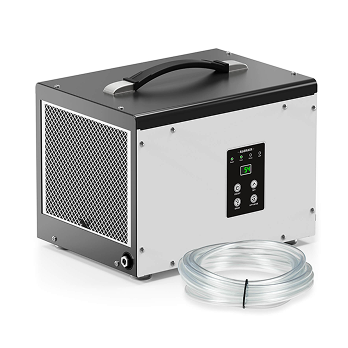
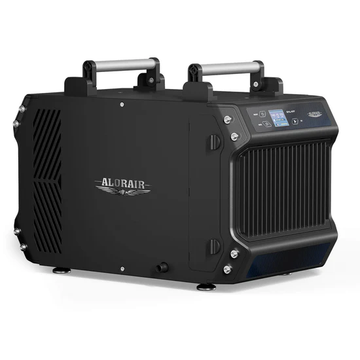
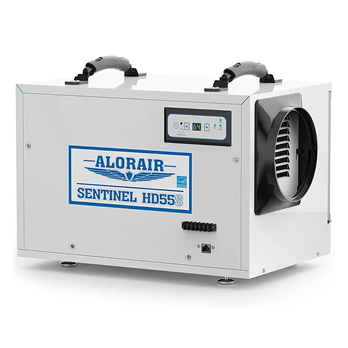
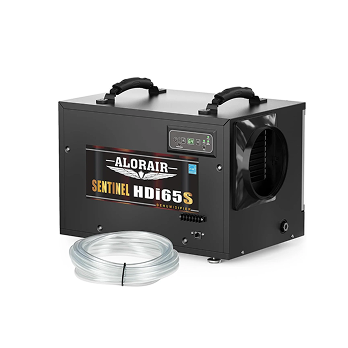



No. An air purifier and a dehumidifier solve different problems. An air purifier filters airborne particles such as dust, pollen and smoke. A dehumidifier removes excess moisture to lower humidity.
Think about what you notice when you walk into the room. A damp basement with condensation calls for moisture control. A dry but dusty living room calls for filtration. If you have both problems, both devices may have a role—but neither fixes a leak or removes mold that is already growing.
Air Purifier vs. Dehumidifier: The Main Difference
One filters particles from the air. The other removes water vapor. The table below shows where each device helps—and where it doesn’t.
What is a Dehumidifier?
A dehumidifier removes water vapor and lowers relative humidity. A refrigerant model pulls humid air across cold coils, where some of the water vapor condenses into liquid. The collected water then flows into a tank, drain hose or condensate pump, and drier air returns to the room.
Its main job is moisture control. It may help reduce condensation, dampness and conditions that support mold or dust mites, but it does not remove existing mold, dust, pollen or smoke from the air.
What is an Air Purifier?
An air purifier uses a fan to move room air through one or more filters. A particle filter may capture airborne dust, pollen, pet dander and smoke particles. Some models also include activated carbon designed to adsorb certain gases and odors.
An air purifier does not lower humidity. Its performance depends on the filter, airflow, clean air delivery rate and room size. It should not automatically be treated as the same product as a commercial air scrubber, which is generally designed for construction, restoration or remediation work.
Comparison Table: At-A-Glance Differences
| Feature | Dehumidifier | Air Purifier |
|---|---|---|
| Main purpose | Removes excess water vapor | Filters airborne particles |
| Effect on humidity | Lowers relative humidity | Does not lower humidity |
| Dust and pollen | Not designed to remove them | May capture them with an appropriate particle filter |
| Smoke | Does not remove smoke particles | May reduce airborne smoke particles; carbon may help with some odors |
| Mold | Helps control moisture that supports growth | May capture some airborne spores but does not remove mold from surfaces |
| Main sizing metric | Pints per day and moisture load | CADR, room size and filter type |
| Typical filter | Model-dependent intake filter that protects internal components | Particle filter, often HEPA; carbon is model-dependent |
| Best for | Dampness, condensation and high humidity | Dust, pollen, pet dander and smoke particles |

Which One Do You Need?
Start with the problem you can observe or measure:
- The room feels damp, or condensation keeps returning: Measure the relative humidity with a hygrometer. If it stays high, find the moisture source and consider a dehumidifier.
- The room is dry, but dust, pollen, pet dander or smoke particles are the concern: Choose an air purifier sized for the room and the particles you want to reduce.
- You have visible mold or a leak: Fix the water source and address the affected materials. Neither machine does that job for you.
- The room is humid and also has an airborne particle problem: You may benefit from both, after dealing with any active water problem.
When Do You Need a Dehumidifier?
A dehumidifier is the more relevant choice when a room feels damp or clammy, relative humidity remains high, or condensation appears on windows, walls or pipes. Basements and crawl spaces often need additional moisture control, but repair leaks, standing water and drainage problems before relying on a dehumidifier.
Common signs of excess moisture include:
- Condensation: Moisture on windows or cold surfaces may indicate high indoor humidity, although surface temperature also affects condensation.
- Musty odors: A persistent musty smell may point to mold or another moisture problem. Reducing humidity can make the environment less favorable for new growth, but existing mold still needs to be removed.
- Dust mite concerns: Maintaining an appropriate humidity range may make the environment less favorable for dust mites, but it does not instantly eliminate mites or allergens already present in bedding and carpets.
The EPA recommends keeping indoor relative humidity below 60% and ideally between 30% and 50%. If you are unsure whether the room is too humid, start by measuring it with a hygrometer.
If the room feels damp but you’re not sure humidity is the problem, measure it first. The indoor humidity levels that feel uncomfortable can help you put that reading in context.
Why Do Both Devices Have Filters?
One reason people confuse the two is that both may contain filters. However, those filters usually serve different purposes.
- Dehumidifier filters: Most are intake filters designed mainly to protect the coils and internal components from larger dust and debris. Filter type and efficiency vary by model.
- Air purifier filters: These are selected specifically for air cleaning. A HEPA filter is designed to capture at least 99.97% of airborne particles measuring 0.3 microns under its rating conditions.
Do not use a dehumidifier as a substitute for smoke filtration. Its intake filter is not designed to provide the particle-removal performance of a properly sized air cleaner.
Can You Use an Air Purifier and Dehumidifier Together?
Yes. The two devices can operate in the same home or room because they manage different problems. A dehumidifier lowers relative humidity, while an air purifier filters particles that pass through it.
Using both may make sense when a damp space also contains airborne dust, pollen or mold particles. However, neither device replaces leak repair, mold cleanup or source control. In a basement or crawl space, fix standing water and drainage problems first, then use a properly sized dehumidifier if humidity remains high.
What Maintenance Does Each Device Need?
Check and clean a dehumidifier’s intake filter as the manufacturer directs. If it uses a collection tank, empty and clean the tank. For continuous drainage, check that the drain line or pump is working.
For an air purifier, replace or clean each filter according to the model’s instructions. A particle filter and an activated carbon filter may have different replacement schedules.

Can One Machine Do Both Jobs?
Some combination units include both dehumidification and air filtration. Check the specifications for each function rather than assuming that an intake filter makes a dehumidifier an air purifier.
For most standalone units, the distinction is simple: a refrigerant or desiccant dehumidifier removes moisture, while an air purifier filters particles. If you need both functions, make sure the equipment is suited to both the room and the problem.
Frequently Asked Questions
Does a dehumidifier clean the air?
Not in the same way as an air purifier. A dehumidifier removes water vapor and lowers relative humidity, but its intake filter is not designed to remove fine airborne dust, pollen or smoke. It may improve conditions indirectly by making the space less favorable for mold and dust mites.
Can an air purifier help with dampness?
An air purifier cannot lower humidity or remove liquid water. If a room feels damp or has condensation, measure the relative humidity and look for leaks, poor drainage or inadequate ventilation. Use a dehumidifier when excess airborne moisture remains after the source has been addressed.
Which one is better for mold?
Neither device removes existing mold by itself. A dehumidifier may help reduce the moisture that supports new growth, while a HEPA air cleaner may capture some spores that become airborne. Existing mold still requires moisture-source correction and physical cleanup.
Can I run both at the same time?
Yes. An air purifier and dehumidifier can run at the same time because they perform different jobs. Using both may help when a room is humid and also contains airborne particles, but not every basement or crawl space needs both devices.
Does an air purifier or dehumidifier cool a room?
Neither device is designed primarily for cooling. A refrigerant dehumidifier usually releases slightly warmer air because of its compressor and condensation process. An air purifier mainly circulates room air and should not significantly change the room temperature.
Conclusion
Choosing between an air purifier and a dehumidifier comes down to the problem you can observe or measure. Choose a dehumidifier for excess humidity, condensation and dampness. Choose an air purifier for airborne dust, pollen, pet dander and smoke particles.
If the space has both moisture and particle problems, the two devices can be used together. Just remember that neither one replaces leak repair, mold cleanup, ventilation or source control. Match the machine to the problem instead of assuming that one device can do it all.
For a basement or crawl space that remains humid after water problems are addressed, basement and crawl space dehumidifiers are one equipment option to compare. Check the space and moisture load before choosing a model.


