
Garage Dehumidifiers for Reliable Humidity Control

Control excess humidity and help protect your vehicles, tools, and stored belongings from moisture-related damage.

  • Free Shipping
  • 6-Year Limited
    Warranty
  • U.S.-Based
    Support

Choose By Your Garage Setup

Start With Your Garage Conditions To Find The Right Fit.

Attached Garage interior

ATTACHED GARAGE RECOMMENDATION

Attached garages often experience milder temperature swings than detached garages, but wet vehicles and humid outdoor air can still introduce moisture. For enclosed spaces up to 1,000 sq. ft. under typical conditions, the compact Sentinel HD35P provides automatic humidity control and flexible drainage.

Sentinel HD35P dehumidifier

Sentinel HD35P

Up to 1,000 sq. ft. 35 PPD at AHAM Pump + gravity drain

Why this model?

  • Compact footprint fits smaller residential garages
  • Automatic humidity control and auto defrost help reduce manual intervention
  • Built-in condensate pump allows upward or longer-distance drainage

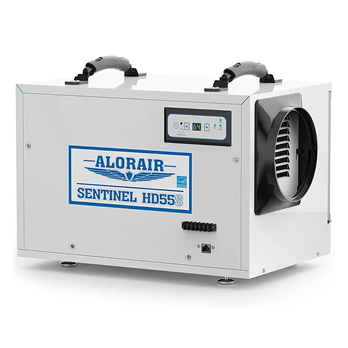
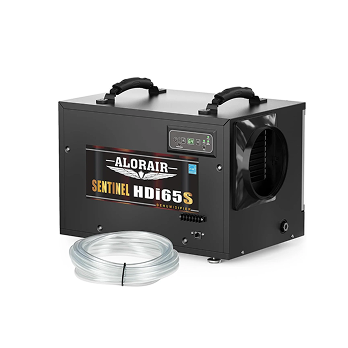
For spaces larger than 1,000 sq. ft., choose the HD55S when gravity drainage is practical or the HDi65S WiFi when pump drainage and remote monitoring are preferred.

Recommended Garage Dehumidifiers

Compare garage-ready models by coverage area, drainage options, and Wi-Fi features.

Why Use a Dehumidifier in Your Garage?

Excess garage humidity can cause lasting damage.

Damp garage with condensation and a parked car Damp garage with condensation and a parked car

Garages can collect moisture from humid outdoor air, wet vehicles, temperature changes, and limited ventilation. A garage dehumidifier helps remove excess moisture and maintain more stable relative humidity, reducing the conditions that contribute to condensation, rust, musty odors, mold growth, and damage to stored belongings.

Condensation on Vehicles and Metal Surfaces

Condensation on Vehicles and Metal Surfaces

Moisture can condense on cold vehicle panels, garage doors, pipes, and metal shelving, increasing the risk of rust and corrosion.

Rust and Corrosion on Tools

Rust and Corrosion on Tools

Prolonged exposure to high humidity can accelerate rust and corrosion on unprotected tools, bicycles, hardware, and lawn equipment.

Mold and Musty Odors

Mold and Musty Odors

Persistent moisture in porous materials—including cardboard, drywall, wood, and fabrics—can create conditions that support mold growth and musty odors.

Damage to Stored Items and Building Materials

Damage to Stored Items and Building Materials

Boxes, paper products, furniture, wood framing, and wall materials can absorb moisture and may warp, stain, or deteriorate over time.

Relative Humidity Gauge

Lower
Target: 40–50% RH
Elevated
High: 60% RH or above

How to Use a Garage Dehumidifier

Follow these four basic steps for effective humidity control.

1

Check the Space
and Humidity

Measure the garage and use a hygrometer to check the current relative humidity. Choose a model rated for the space size, moisture level, and operating temperature.

2

Choose the
Right Location

Place the dehumidifier on a stable, level surface with the air inlet and outlet unobstructed. Follow the model’s clearance requirements and keep the unit out of vehicle paths.

3

Set Up Continuous
Drainage

Use gravity drainage when the hose can slope continuously downward to a lower drain. Use a pump-equipped model when condensate must be lifted or gravity drainage is not practical.

4

Set the Target
Humidity

Set the humidistat between 45% and 50% as a practical starting point. Use automatic humidity control so the unit cycles as needed.

Frequently Asked Questions

1. Should I run a dehumidifier in my garage all the time?

Usually not. For most garages, Auto mode with the humidistat set to a target RH is more practical than continuous operation. The unit can turn on when humidity rises and stop when it reaches the set point, avoiding unnecessary runtime.

Continuous operation may be appropriate temporarily during the initial dry-down period or after unusually humid conditions. However, standing water and active leaks should be removed or repaired before relying on a dehumidifier.

If the unit runs continuously without lowering the measured RH, check whether its capacity matches the garage’s size and moisture condition. Also inspect door and window gaps, active leaks, blocked airflow, a full tank or drainage problem, and the unit’s minimum operating temperature.

2. What should I set my garage dehumidifier to?

A setting of about 45% to 50% RH is a practical starting point for many garages. Use a separate hygrometer to confirm the actual humidity rather than relying only on the unit’s display.

If condensation continues to form on garage doors, windows, pipes, tools, or other cold surfaces, lower the setting gradually and monitor the results. In cold weather, a lower indoor RH may be necessary to reduce condensation, but you should also confirm that the dehumidifier is rated to operate at the garage’s temperature.

Avoid setting the target lower than necessary. An unnecessarily low setting increases runtime and energy use without always providing a meaningful additional benefit.

3. What size dehumidifier do I need for a garage?

Match the unit to the garage’s square footage, insulation, temperature, current humidity, and moisture condition. A small, dry, attached garage generally needs less capacity than a large, uninsulated garage in a humid climate.

Compare capacity in pints per day, but make sure the models use the same rating conditions. AHAM or DOE-rated capacity and saturation-condition PPD are not directly interchangeable. See the comparison chart above for sizing by coverage area and moisture condition.

If the garage has standing water, foundation seepage, an active leak, or repeated flooding, address the water source before selecting a dehumidifier.

4. What size dehumidifier do I need for a 2-car garage?

A typical 2-car garage runs roughly 400 to 600 sq. ft., which usually falls in the 50–70 PPD range for a moisture-controlled space. Garages with higher humidity, poor insulation, frequent door use, or an attached workshop area may need a higher-capacity unit — check the comparison chart above to match PPD to your garage's actual size and conditions rather than square footage alone.

5. Should I choose a garage dehumidifier with a built-in pump or a drain hose?

Choose a built-in pump if your drain point is above the unit or farther away than gravity can reach — the pump pushes water up and out. Choose a gravity drain hose if a floor drain sits below the unit; it's simpler, with nothing to maintain. Both support continuous drainage so you don't have to empty a bucket.

Related Articles

Explore practical guides to help you choose, place, and use a garage dehumidifier effectively.

View AllView More